


Usain Bolt's 100m record: An achievement that astonished the world.
100m running record It's not just a number recording the fastest time an athlete can run over 100 meters, but also a symbol of relentless striving and the desire to conquer seemingly impossible limits. From rudimentary stopwatches to modern sensor systems, this journey to conquer the speed of light is a story full of effort, legends, and incredible scientific and technological breakthroughs.
Usain Bolt – a legend of the 100m race.
Usain Bolt, a name that has become legendary in the world of athletics, especially in the 100m race. With his exceptional height and extraordinary stride, the Jamaican "Lightning Bolt" has not only broken records but also redefined what an athlete can achieve. His journey from a sports-loving boy to a global icon is an endless source of inspiration for millions around the world.

Athlete's Profile: From Jamaican Boy to World Athletics Icon
Usain St. Leo Bolt was born on August 21, 1986, in Trelawny, Jamaica. At 1.95 meters tall, he possessed an undeniable natural physical advantage over his competitors. From a young age, Bolt showed exceptional talent in sports, particularly cricket and soccer. However, his coaches recognized his superior potential in track and field and encouraged him to focus on sprinting.
Bolt began achieving his first successes at the U20 level, winning a gold medal at the 2002 World Junior Athletics Championships. His career quickly developed, marking a major turning point in 2008. At the Beijing Olympics, he stunned the world by winning gold medals in both the 100m and 200m events, simultaneously breaking world records.
The period from 2009 to 2016 was the peak of Usain Bolt's career. He continued to dominate major competitions, from the 2012 London Olympics to the 2016 Rio Olympics, winning numerous gold medals and solidifying his position as the greatest sprinter of all time. His illustrious career has left an indelible legacy in athletics history.
Nicknamed "The Lightning Bolt": Why has Usain Bolt become a global icon?
The nickname "Lightning Bolt" not only describes Usain Bolt's extraordinary speed on the track but also reflects his unique playing style and personality. He is not only an outstanding athlete but also a talented performer, always delivering inspiring and exciting performances for the audience.
Usain Bolt's relaxed attitude, unique celebration style, and excellent communication skills have made him a global media icon. He easily attracts the attention of the media and fans, creating a wave of fervent adoration around the world. His image appears on the covers of leading magazines, in global advertisements, and on social media.

Usain Bolt has made a tremendous contribution to promoting athletics to the world. He has captured the attention of millions, making athletics more popular and appealing to young audiences. He has proven that athletics is not just a sport but also a captivating form of entertainment. He is not just an athlete but also an ambassador for the sport.
Other notable achievements include: 200m, 4x100m, and the post-Bolt Olympics.
In addition to his resounding successes in the 100m race, Usain Bolt has also achieved many impressive accomplishments in other events, including:
- The 200m record: 19.19 seconds, set at the 2009 Berlin World Championships. This achievement remains the world record to this day.
- The 4x100m relay record is 36.84 seconds, set at the 2012 London Olympics with the Jamaican team.
Usain Bolt won gold medals in three consecutive Olympic Games: Beijing 2008, London 2012, and Rio 2016. He became the only athlete in history to win a double gold medal in both the 100m and 200m events in three consecutive Olympic Games.
Usain Bolt's retirement has left a huge void in the world of athletics. Without him, major competitions have become less attractive. Finding a worthy successor is a major challenge for administrators and young athletes alike. However, his legacy continues to inspire future generations of athletes.
The 9.58-second record – a moment that changed the history of athletics.
Usain Bolt's record of 9.58 seconds at the 2009 Berlin Athletics World Championships is not just a number, but a symbol of human excellence. It was a historic moment that changed how we perceive the limits of speed and the capabilities of the human body. This record has become a challenging goal for athletes worldwide, a milestone they always aspire to conquer.

Events at Berlin 2009: Competition conditions, opponents, and Bolt's tactics.
On August 16, 2009, at the Berlin World Athletics Championships, Usain Bolt stepped onto the 100m track determined to break the world record. He faced formidable opponents such as Tyson Gay (USA) and Asafa Powell (Jamaica), who were also eager to win.
The competition conditions in Berlin that day were considered ideal. The playing field met the highest standards, and the wind speed (0.9 m/s) was just right to support the athletes without violating regulations. The weather was also very favorable, with warm temperatures and low humidity.
Bolt's strategy in this race was to focus on a good start and maintaining high speed throughout the race. He had a less-than-perfect start, but quickly regained the advantage thanks to his long stride and extraordinary strength.
Analyzing Bolt's running technique in his classic performance.
Usain Bolt's performance at the 2009 Berlin Olympics is a classic example of perfect running technique. Despite a slower start than his competitors, Bolt quickly accelerated and took the lead from about 30m to 80m.
Bolt's long stride (2.44m/step) is one of the most important factors that helps him achieve extraordinary speed. He is able to generate powerful propulsion and maintain high speed throughout the race. While Bolt's stride frequency isn't as high as some other athletes, it's highly effective thanks to his strength and the perfect coordination between his muscle groups.
Bolt's peak speed in this race is estimated at around 44.7 km/h, an astonishing figure. He demonstrated remarkable body control and the ability to maintain high speed for extended periods, something few athletes can do.
Global reaction: What are the media and experts saying?
Usain Bolt's record of 9.58 seconds shocked the world. The media and athletics experts alike expressed astonishment and admiration for this extraordinary achievement.

The Guardian called it a "run that transcends time," emphasizing that Bolt had broken seemingly impossible human limits. The IAAF (International Athletics Federation) also hailed Bolt as "the greatest athlete of all time."
Many experts predict that Bolt's record will be very difficult to break in the near future. They believe that to achieve this feat, an athlete needs a perfect combination of talent, technique, strength, and favorable competition conditions. However, there are also those who believe that with advancements in science and technology, this record could be broken even further in the future.
The evolutionary history of the men's 100m running record.
The journey to conquering the men's 100m record is a long story, beginning in the early 20th century with rudimentary stopwatches and still-controversial numbers. Over time, with advancements in science, technology, and training methods, this record has been continuously broken, taking human speed to new heights.
Milestones before Usain Bolt: Jim Hines, Calvin Smith, Donovan Bailey…
Before Usain Bolt emerged, many other outstanding athletes had already contributed to the history of the 100m race. Here are some of the key milestones:
- 1968: Jim Hines – 9.95 seconds (Mexico City Olympics). This was the first time a human ran the 100m in under 10 seconds, a historic milestone in world athletics.
- 1983: Calvin Smith – 9.93 seconds (Colorado Springs). Smith broke Hines' record with this new achievement.
- 1996: Donovan Bailey – 9.84 seconds (Atlanta Olympics). Bailey won the Olympic gold medal and broke the world record.
Before Bolt's dominance, Asafa Powell and Justin Gatlin also held world records, demonstrating the fierce competition and continuous progress of top athletes.
The impact of technological advancements: shoes, road surfaces, timing devices.
Advances in technology have played a significant role in improving the performance of 100m runners. Improvements in shoes, track surfaces, and timing devices have helped reduce drag, increase grip, and ensure greater accuracy.
- Spike shoes: Spike shoes are becoming lighter and more elastic, helping athletes generate more propulsion and run faster.
- Mondo track surface: The Mondo track surface is made from a special material that provides excellent force feedback and minimizes injury to athletes.
- Laser and reactive sensor timers: Modern timekeeping devices utilize laser and reactive sensor technology, ensuring absolute accuracy.
The modern era: When performance approaches biological limits
In the modern era, with the remarkable advancements in science and technology, the performance of 100m runners has approached the biological limits of the human body. Scientists believe it is very difficult to improve speed further in the future.
Factors such as genetics, technique, strength, speed, reflexes, psychology, nutrition, and training all play a crucial role in determining the highest limits of human performance. Optimizing all of these factors is a major challenge for athletes and coaches alike. However, with continuous effort, we may witness new records being set in the future.
A new generation attempts to break records.
Usain Bolt's record of 9.58 seconds remains an unassailable benchmark, but that hasn't stopped young athletes around the world from striving to break it. The new generation of sprinters is bringing new hope to the world of athletics, with their admirable talent and dedication.
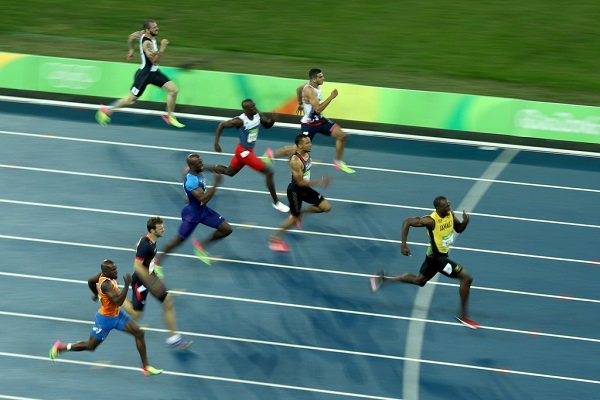
Fred Kerley, Noah Lyles and their progress towards the 9.58-second mark.
Fred Kerley (USA) and Noah Lyles (USA) are two of the most talented young athletes today. Kerley achieved a time of 9.76 seconds, showing his great potential to break the world record. Lyles also once ran 9.83 seconds, and he is a formidable competitor in the 100m race.
Both Kerley and Lyles have shown consistency in the Diamond League and World Athletics competitions, demonstrating their ability to compete at the highest level. They are constantly striving to improve their technique, strength, and speed, hoping to one day break Usain Bolt's record.
Yohan Blake and Tyson Gay: Almost reached the mark but couldn't surpass it.
Yohan Blake (Jamaica) and Tyson Gay (USA) are two athletes who have come very close to Usain Bolt's world record. Blake achieved a time of 9.69 seconds in 2012, while Gay also ran 9.69 seconds but was later found guilty of doping.
Both Blake and Gay competed during the era of Usain Bolt, and they faced immense competitive pressure from the Jamaican legend. Despite their talent and effort, they were unable to surpass Bolt.
Influencing variables: age, physical endurance, competition schedule
Many factors can influence an athlete's ability to break a world record. Age, physical endurance, and competition schedules are all important factors to consider.
The "golden age" for a 100m runner is typically between 24 and 27 years old. During this period, the athlete's body reaches optimal maturity in terms of strength and speed. However, after this age, issues such as injuries, declining physical fitness, and psychological pressure can affect performance.
Physical endurance is also a crucial factor. Athletes must maintain good health and fitness to compete at the highest level. Regular training, proper nutrition, and effective recovery measures will help them optimize their performance on the track.
Competition schedules also have a significant impact on athletes' performance. A packed schedule can lead to fatigue, injury, and decreased performance. Managers and coaches need to carefully consider their athletes' schedules to ensure they can maximize their potential without unnecessary risks.
The women's 100m record – a time of 10.49 seconds by Florence Griffith-Joyner.
The women's 100m record is currently held by Florence Griffith-Joyner (Flo-Jo) with a time of 10.49 seconds, a very difficult milestone to break. This record not only demonstrates Flo-Jo's exceptional talent but also reflects the historical context of women's sports in 1988.

The track record and context of 1988: Why is it so difficult to surpass?
Flo-Jo truly shone at the 1988 Seoul Olympics, where she achieved a memorable feat with a time of 10.49 seconds. Favorable weather conditions, along with perfect preparation, contributed to her setting the record. However, what kept this record standing for nearly four decades was the perfect combination of physique, technique, and competition strategy.
Flo-Jo's powerful style of play, coupled with her confidence and determination, made her an icon in the world of athletics. At the time, wind conditions were also controversial; although the wind speed was measured at 0.0, many argued that these conditions gave her an advantage. Despite the controversy, it's undeniable that this achievement marked a turning point in the history of women's sports.
Comparing average speeds between male and female athletes.
An interesting aspect of comparing achievements between men and women is average speed. Usain Bolt averages around 37.6 km/h, while Flo-Jo's average speed is around 34.5-35 km/h. This difference stems not only from biological factors but also from how each gender demonstrates strength and speed in their respective sports.

This reflects the biological and anatomical realities of both sexes. While women can also achieve outstanding performance, there are certain physical limitations that remain insurmountable to this day. Continuing scientific research indicates that genetic, hormonal, and muscular development and changes may influence the physical capabilities of each sex.
Biological limits in women: Can they be overcome in the future?
While contemporary athletes like Elaine Thompson and Shelly-Ann Fraser are still striving to improve their performance, the gap to Flo-Jo's record remains quite large. They came close to the record, with a time of around 10.6 seconds, just 0.1-0.2 seconds short of breaking it.
Advances in sports technology, training methods, and nutrition could bring about significant changes in the future. However, the question remains whether records like Flo-Jo's will ever be broken. That is still uncertain, as it depends on the progress of sports science and the development of individuals in the future.
Scientific factors that enable a person to run extremely fast.
When it comes to running fast, the role of scientific factors cannot be ignored. Genetics, body structure, and environmental factors all influence an athlete's performance.
Genetics & Body Structure
Genetics plays a crucial role in determining a person's running ability. Athletes with a high proportion of fast-twitch muscle groups tend to run faster. Additionally, lower limb length is a key factor; those with longer legs can often achieve a larger stride, thereby increasing speed.
Bone density is also a factor to consider. Athletes with lower bone density tend to react to force more quickly and efficiently. This is one of the reasons why training and genetics are so closely linked in creating the perfect running machine.
Running technique & starting reflexes
Running technique is one of the key factors determining speed. Reaction time at the start is a small detail, but it can make a huge difference. An athlete who can somehow achieve a reaction time under 0.13 seconds has a tremendous advantage on the track.
The angle of the body and the way force is distributed in the first three strides also play a crucial role. These initial strides can determine who will take the lead in a race, especially in intense competitions like the Olympics.
The role of the coach, competitive psychology, and individual motivation.
It's undeniable that coaches play a major role in an athlete's career. The right training system helps improve technique and optimize performance. For example, Jamaica Camp is renowned for its unique training style, producing many sprint champions.
In addition, psychological factors also greatly influence performance. On a large stage, pressure from the audience and expectations from oneself can affect an athlete's decisions and performance results. Personal motivation is a huge driving force that helps them overcome all difficulties and challenges.
Conclude
Usain Bolt's 100m record and other outstanding achievements in athletics have opened a new chapter for world sports. Intense competition, scientific factors, and technological advancements have created fascinating stories of human strength and record-breaking feats. While many young athletes are striving to break these records, the future remains promising with advancements in sports science and the continuous development of human capabilities.