


A complete guide to standard badminton court dimensions.
Badminton is one of the most popular sports worldwide, attracting a large number of players of all ages. To train and compete effectively in badminton, understanding the correct dimensions of a badminton court is crucial. This article will provide you with detailed information on standard badminton court dimensions, necessary equipment, and helpful regulations and guidelines for drawing a standard competition court.
Regulations on badminton court dimensions
The size of a badminton court plays a crucial role in ensuring fairness and quality of play. Understanding and adhering to size regulations will help players develop their skills scientifically and facilitate the organization of professional tournaments.
Standard badminton court dimensions
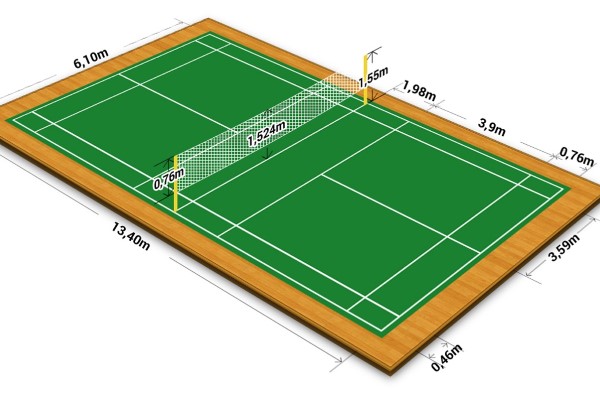
According to the Badminton World Federation (BWF) regulations, the standard size of a badminton court is 13.4m x 6.1m, with the length of the court being 13.4m and the width being 6.1m. The court is divided into two equal halves by a net stretched horizontally in the middle, with the net reaching a height of 1.524m at the center point.
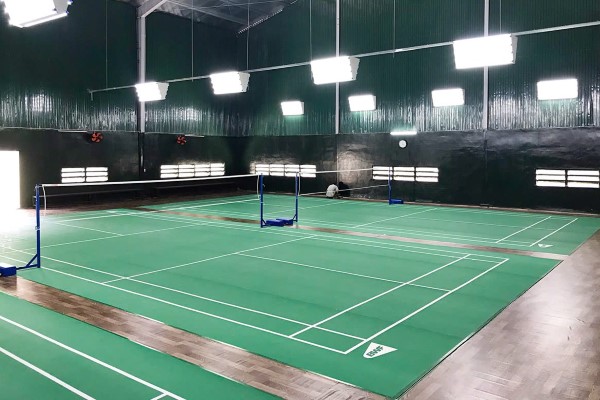
For indoor courts, the height from the court surface to the ceiling must be at least 7 meters to avoid obstructing the ball's trajectory. The distance from the outer edges of the boundary lines to surrounding obstacles such as walls and grandstands must be at least 1 meter. In addition, the court surface must be flat, non-slip, and made of durable materials such as wood, synthetic resin, rubber, or cement.
Single badminton court dimensions
In men's and women's singles badminton, the court dimensions are similar to doubles (13.4m) in length, but narrower in width, at only 5.18m. The area outside the singles court boundaries (called the sidelines) is not included in the playing area. The singles court boundaries are marked with white or yellow lines inside the court on both sides of the net.
Double badminton court dimensions
For men's doubles, women's doubles, and mixed doubles, the playing area is larger than the singles court, with standard dimensions of 13.4m x 6.1m. This provides each pair with more space to move around and execute their hitting techniques. The outer boundary line of the doubles court coincides with the main boundary line of the entire playing court.
What are the characteristics of a badminton court?
To better understand a standard badminton court, let's explore its basic characteristics, including layout, area, design specifications, and some other important regulations.
Badminton court layout
A standard badminton court includes the following main components:
- Sidelines: These are two parallel lines, 13.4 meters long, that define the two sides of the court's width.
- Back boundary lines: These are two horizontal lines at either end of the court, defining the length of the court, and are 6.1 meters long.
- Center line: A straight line parallel to the goal line, dividing the field into two equal halves.
- Service line: Two parallel lines, 1.98m from the net on each side.
- The center service line is a straight line connecting two midpoints of the service line, dividing the service area into two equal halves.
All court lines are 4cm wide. The distance from the net post to the sideline is 0.5m on each side.
Standard badminton court area
With dimensions of 13.4m x 6.1m, the total area of a standard badminton court is 81.74m2. Of this, the area of each half of the court (excluding the net) is 40.87m2. In official competition venues, there is also space around the playing area for the technical area, spectator area, and walkways of appropriate size.
Badminton court design specifications
To ensure the quality and safety of a badminton court, the following design specifications must be followed:
- The playing surface must be flat, smooth, and provide adequate grip and friction.
- The playing area is surrounded by corridors at least 1 meter wide, providing space for players to move around.
- The lighting system must meet standards of 500-1000 lux, be evenly distributed across the court, and not cause glare.
- Wood decking or specialized composite materials should be used for paving the patio surface, avoiding ceramic tiles or marble.
- The walls and ceilings must have good soundproofing capabilities to prevent external noise from affecting the interior.
- The court needs to be well-ventilated and maintain a cool temperature between 18-25°C to create the best playing conditions.
Some rules on the badminton court
For a fair and professional match, players need to understand some basic rules when playing on the field, such as:
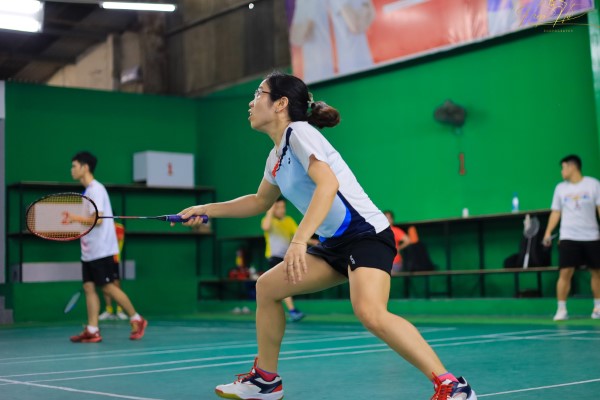
- Players are not allowed to touch the net, the net posts, or encroach on the opponent's court.
- When serving, the right foot must make contact with the court surface; it must not step on the court lines.
- The ball is considered valid when it crosses the net and lands in the opponent's court (even if it touches the boundary line).
- The shuttlecock is considered a fault if it lands out of bounds, doesn't go over the net, or is returned to the player's own court by an opponent...
During the match, if there is a dispute over the ball or the score, the referee will make the final decision based on the rules of the game.
Regulations require equipment that meets standard badminton court dimensions.
Besides ensuring standard dimensions, badminton courts also need to be fully equipped with essential, standard-compliant equipment. Below are the regulations regarding badminton court equipment that you should be aware of.
Badminton court net posts
Net posts are essential equipment for setting up a net to divide the court into two halves. The regulations regarding net posts are as follows:
- The posts must be placed vertically, perpendicular to the ground, and must not be tilted.
- The top of the pole is 1.55m above the ground.
- The posts are typically made of metal, wood, or composite materials, and are carefully padded to protect the netting.
- The distance from the goalpost to the sideline must be at least 0.5m to avoid obstructing players.
Proper and secure installation of the net tensioning posts will ensure the net remains taut and flat, guaranteeing the professional quality of the match.
Badminton net
The net is an extremely important element, determining the quality of each shot exchanged between the two sides of the court. Regulations regarding badminton nets include:
- The net is 6.1 meters long, the same as the width of the court.
- The net, when stretched across the court, is typically 75-80cm wide, usually with an 8cm wide white band on top.
- The mesh is made from high-quality synthetic fibers, polypropylene, or nylon, woven into square holes with sides measuring 1.5-2cm.
- The net must be stretched taut and flat, with the center of the net at a height of 1.524m and the posts at both sides at a height of 1.55m.
Nowadays, most badminton courts use professional, standard-compliant nets to create high-quality and exciting matches.
Height of the badminton court roof
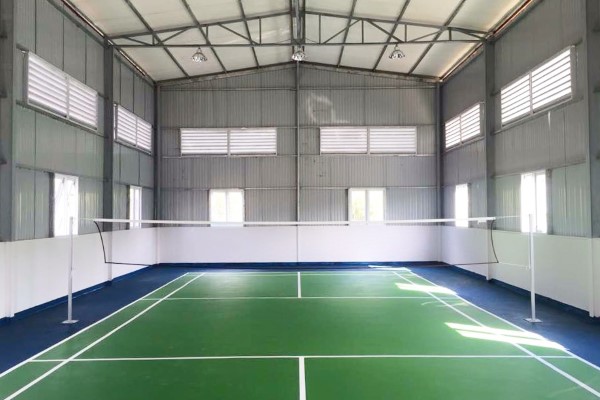
For indoor badminton courts with roofs, the following regulations regarding the height from the floor to the roof must be ensured:
- A minimum distance of 7 meters is required if there are no supporting pillars in the competition area.
- A minimum of 9 meters is required if there are supporting pillars in the yard.
- Ideally, the roof height should be between 10-12 meters to create ample space. A court with a suitable roof height will minimize obstruction to the ball's trajectory and help players feel comfortable during matches.
Some lines are drawn to the correct dimensions for a standard badminton court.
In addition to the main boundary lines, a badminton court needs to ensure the dimensions of important lines such as:
- The distance from the serve line to the net is 1.98m.
- The singles service line is 0.76m from the center line on each side.
- The center line divides each side of the court into two equal halves.
- The baseline runs parallel to the net, 6.7 meters from the center of the net in each direction.
The sharper, more uniformly thick, and easier to see the lines are, the faster and more accurately players can determine the boundaries of the field.
Instructions on how to draw a badminton court that meets competition standards.
To create a badminton court that meets competition standards, we need to follow these design and drawing steps:
- Prepare a flat court surface, made from wooden planks or other specialized materials.
- Determine the center of the field and mark it with a temporary landmark.
- Starting from the center line, draw the center line, then draw the sidelines on both sides, 3.05m apart. Next, draw the end lines at both ends of the field, 6.7m from the center.
- Draw the service line parallel to the net, 1.98m from the net on each side.
- Draw singles service lines, 0.76m from the center line on each side.
- Double-check the dimensions, adjusting if necessary to ensure absolute accuracy.
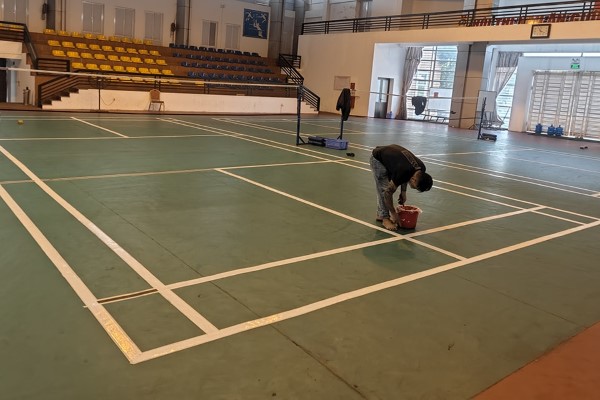
- Use paint or specialized masking tape to draw the lines; the line width should be 4cm.
The process of marking a badminton court requires meticulousness, care, and expertise. It's best to seek the assistance of experienced professionals or companies to ensure the court is properly marked and ready for training and competition.
Some questions about badminton court dimensions
Why do badminton courts have two lines?
Badminton courts have both single and double lines because they are designed to accommodate various competition formats. In men's or women's singles matches, players only use the court area inside the single-court lines, which is 5.18 meters wide. In doubles, the entire 6.1-meter wide court is the competition area for pairs of athletes. Having both types of lines marked makes the badminton court more flexible, accommodating all competition formats.
What is the width of the badminton court boundary lines?
According to the standards of the Badminton World Federation (BWF), the boundary lines on a badminton court, including the sidelines, end lines, service lines, and center line, must all have a standard width of 4cm. This requirement ensures consistency and clarity, avoiding unnecessary confusion or disputes. The paint or tape used to draw the lines must also meet standards, be colorfast, and easily recognizable.
What are badminton courts made of?
Badminton courts are made from various materials, depending on their intended use and installation conditions. Professional courts typically use wood planks or specialized PVC flooring, with surfaces treated to ensure grip, balance, and elasticity for the shuttlecock. These materials are durable, wear-resistant, easy to maintain, and replace. In addition, some more common badminton courts may use cement or concrete surfaces coated with rubber or epoxy paint. However, these types of surfaces are often less elastic and can put strain on the knee joints during practice.
Top badminton tournaments today utilize specialized court technologies such as movable floor frames, LED-lit nets, and multi-layered wooden floors to enhance the experience and provide spectacular matches for fans.
Conclude
With this detailed information about standard badminton court dimensions, we hope you have gained useful knowledge to train and compete more effectively. Don't forget to visit Sportz Warrior at https://sportzwarrior.com/ – Your source for the latest news, commentary, and information on all sports. Daily updates with news, matches, and in-depth analysis from experts. Join us on our journey to discover the beauty and power of sports!
